Overview
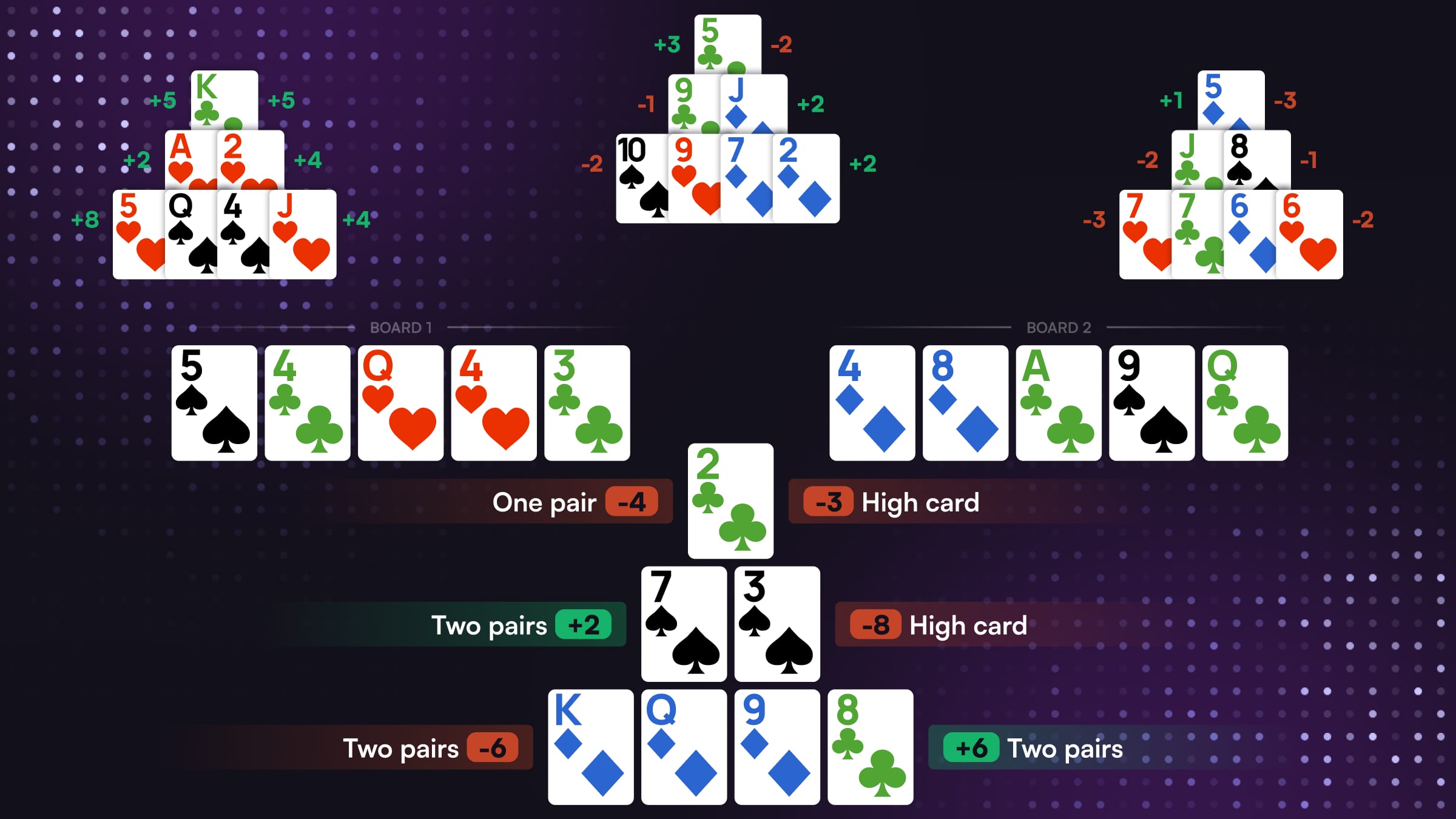
Taiwanese Poker is a point-based, card-setting game played with a standard 52-card deck by up to 6 players.
Instead of betting chips, players compete for points. Every point is assigned a dollar value before the game starts, so a hand worth 20 points at $0.50/pt is worth $10.
Each player is dealt seven cards and arranges them into three separate poker hands:
- Top — a 1-card Hold'em hand
- Middle — a 2-card Hold'em hand
- Bottom — a 4-card Omaha hand
Unlike Open-Face Chinese, there is no ordering requirement between your rows. Your Top can be stronger than your Bottom — each row is scored as its own independent game, so there is no way to foul.
How a Round Works
The Deal
Every player receives 7 cards, face down and hidden from opponents.
Setting Your Hand
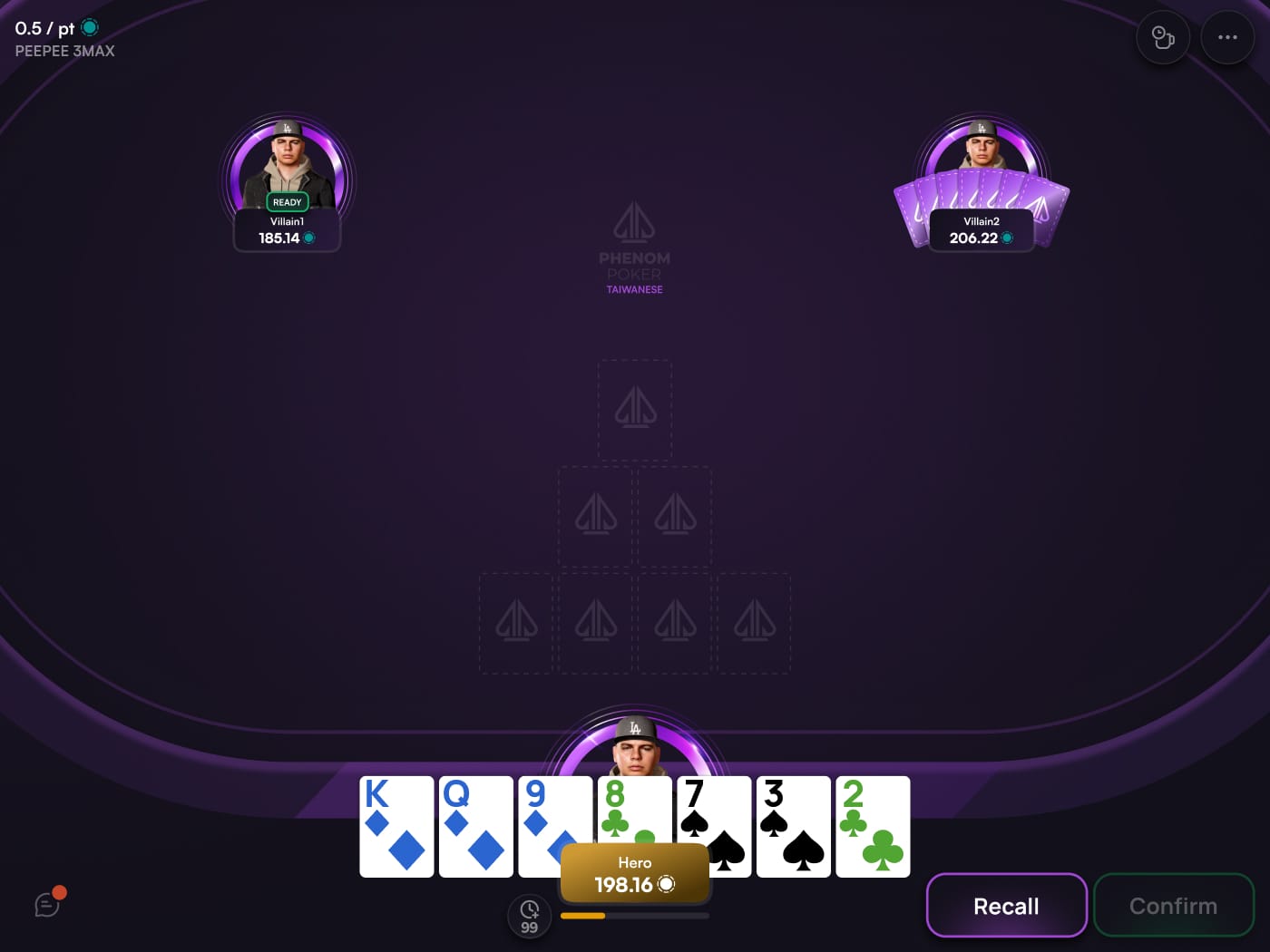
Place your cards into the three rows: 1 card on Top, 2 in the Middle, 4 on the Bottom.
Use Recall to pull your cards back and start over, and Confirm to lock your setup in. All players set at the same time — nobody sees anyone else's arrangement until every hand is locked.
The Boards
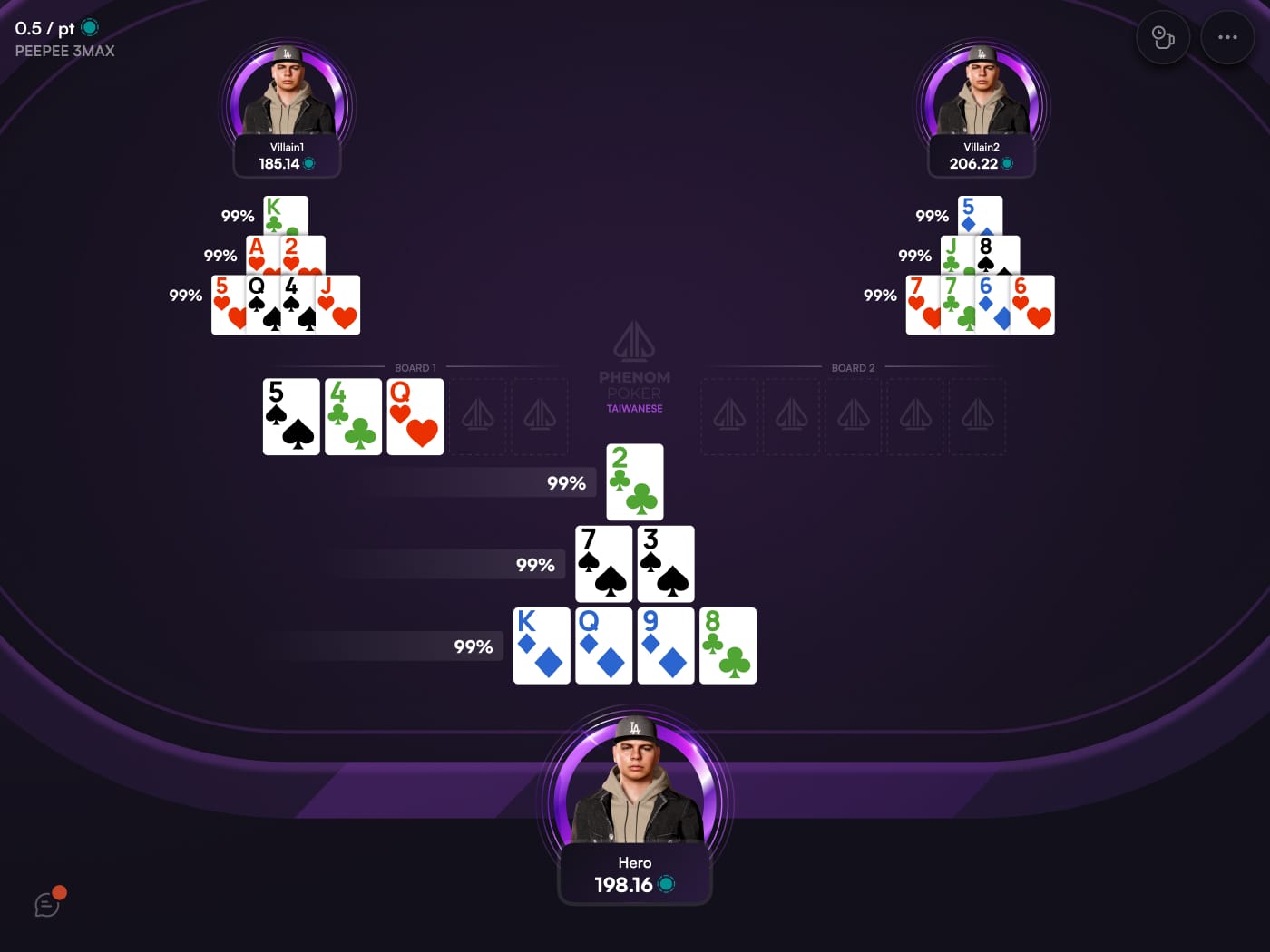
Once every player has confirmed, two 5-card boards are dealt face up in the middle of the table.
Both boards are live for every player. Your seven cards play against Board 1 and against Board 2 — two showdowns from a single setup.
Showdown
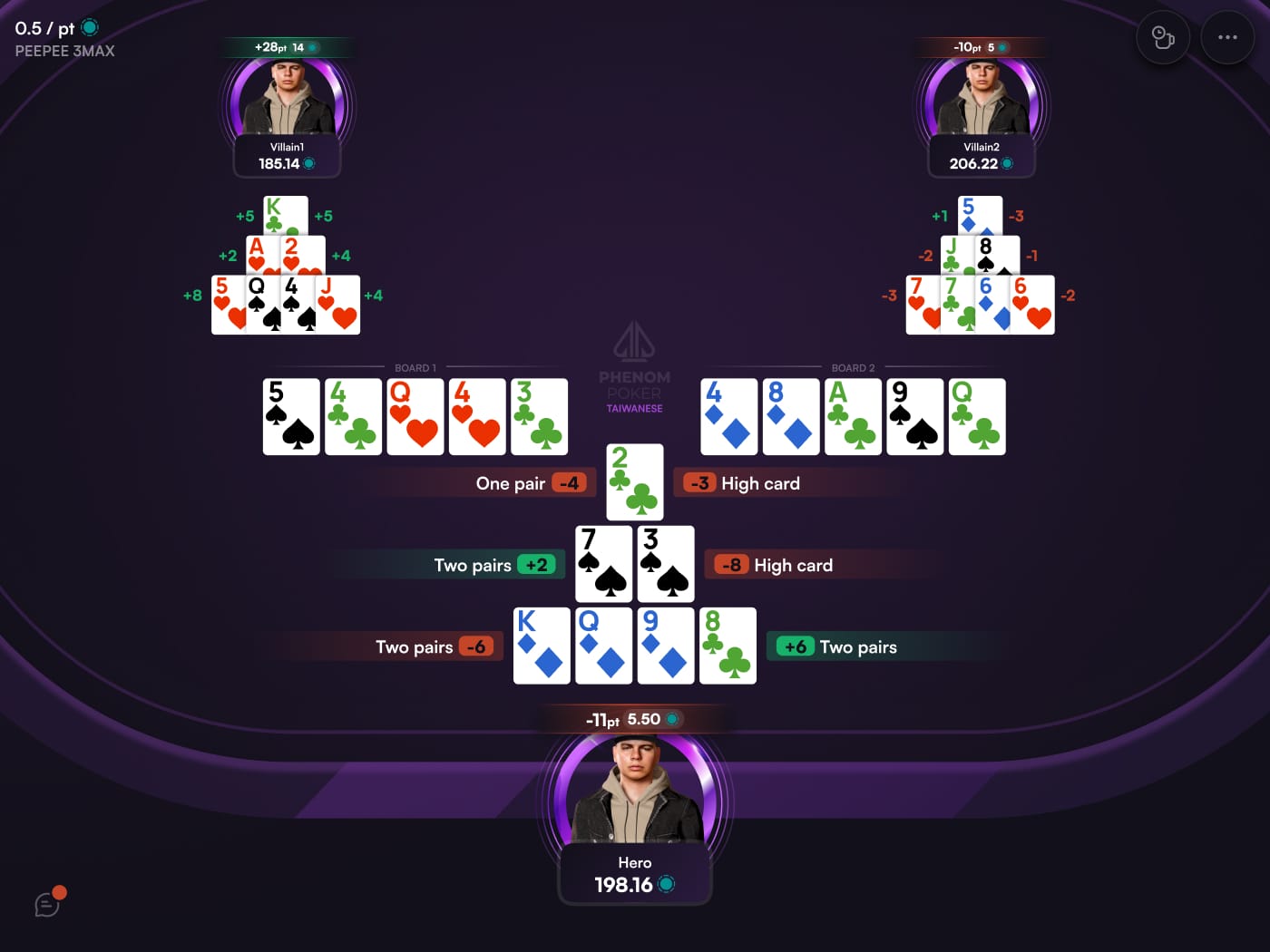
Every row is compared row against row, board by board: your Top vs their Top on Board 1, your Middle vs their Middle on Board 1, and so on across both boards.
In multi-way games, you are scored against each opponent separately.
Scoring
Points are added up per row, per board, per opponent, then settled at the table's point value.
Building Each Row
This is where Taiwanese Poker differs from every other set-building game — each row uses different rules.
Top — 1-Card Hold'em
Your single card plays with the five board cards, Hold'em style. Your best five-card hand can even be the board itself.
Middle — 2-Card Hold'em
Your two cards play with the board, Hold'em style. You may use both, one, or neither of them.
Bottom — 4-Card Omaha
Omaha rules apply: you must use exactly two of your four cards and exactly three from the board. No more, no less.
Because the Bottom is worth the most points and is the most restrictive row, it usually deserves your strongest four cards.
Scoring System
Each row carries a different value:
Row | Points |
|---|---|
Top | 1 point |
Middle | 2 points |
Bottom | 3 points |
You win the points on every row you take and lose them on every row you drop. Tied rows are worth zero to both players.
That makes each board worth 6 points, and the full hand worth 12 points against a single opponent.
Homerun
If you scoop an opponent on both boards — winning all three rows on Board 1 and all three rows on Board 2 — you score a Homerun.
A Homerun pays an 8-point bonus on top of the 12 points you already won:
6 + 6 + 8 = 20 points
That is the maximum you can win from one opponent in a single hand, and the reason a marginal Bottom row is worth defending.
Jokers
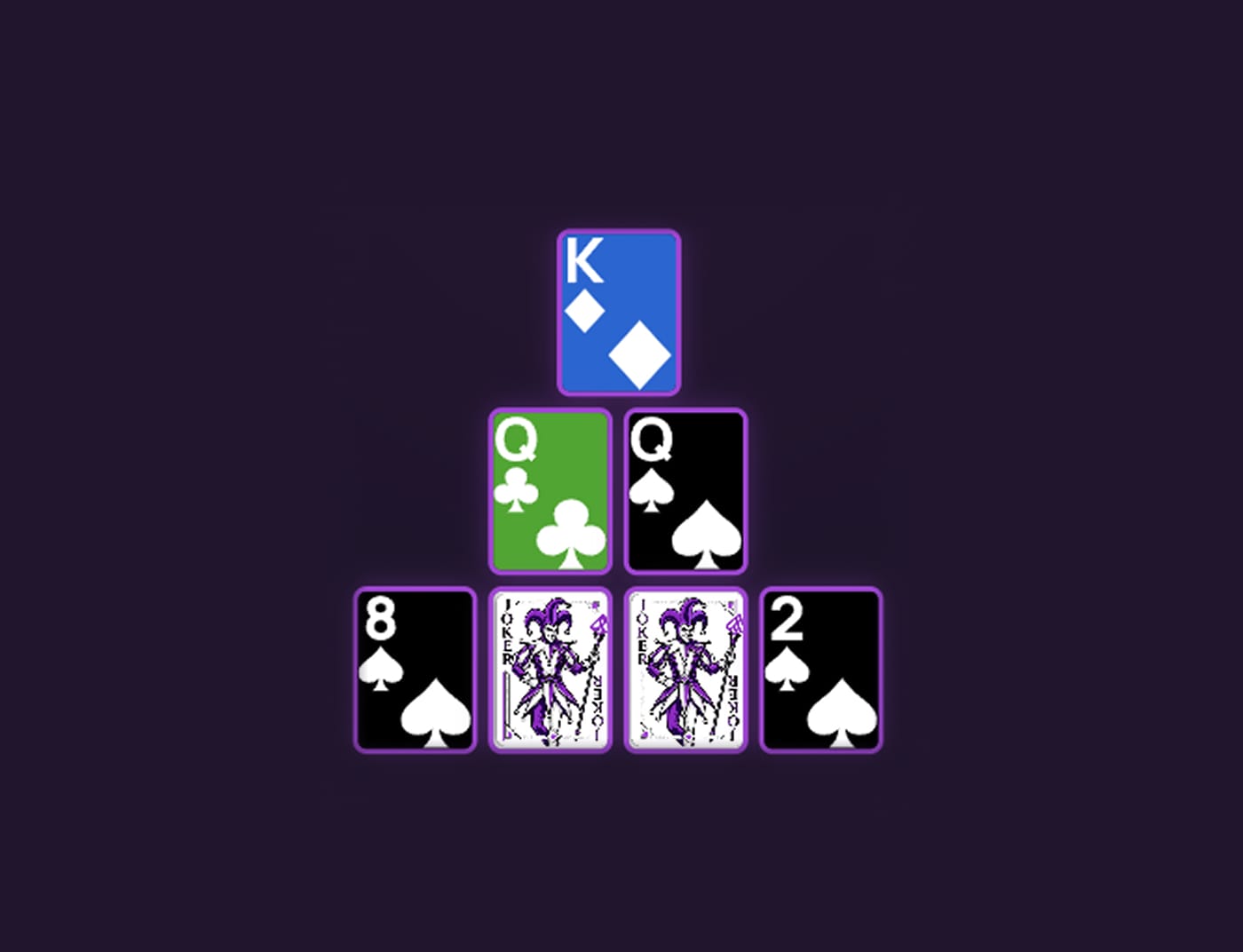
Similar to the joker variant of OFC, Jokers can be used as wilds to be played as the best possible combination the player can make. This adds for a fun twist on traditional Taiwanese.
- Jokers are only dealt to the player hand and are not dealt on the board.
- The deck contains 2 Jokers.
Quick Tips for New Players
- Protect the Bottom. It is worth half the points on each board — three of six.
- Remember the Omaha rule. Four pretty cards on the Bottom mean nothing if you cannot make two of them play with three from the board.
- Set for two boards, not one. A hand built to smash one specific board will often miss the other. Balanced setups scoop more often.
- Chase the Homerun, but count first. The 8-point bonus is worth more than the Top and Middle rows on both boards combined.
- Watch the percentages. Once the boards are out, Phenom Poker shows live win percentages for every row so you can see exactly where each board stands.